It’s 1981, and the world is still mostly analog.
The city has payphones with spiral cords that never unkink, cars that smell like vinyl and gasoline, and TVs that go thunk when you turn them on. But in Dave’s basement—half laundry room, half kingdom—something is happening that feels like the future sneaking in through a cracked window.
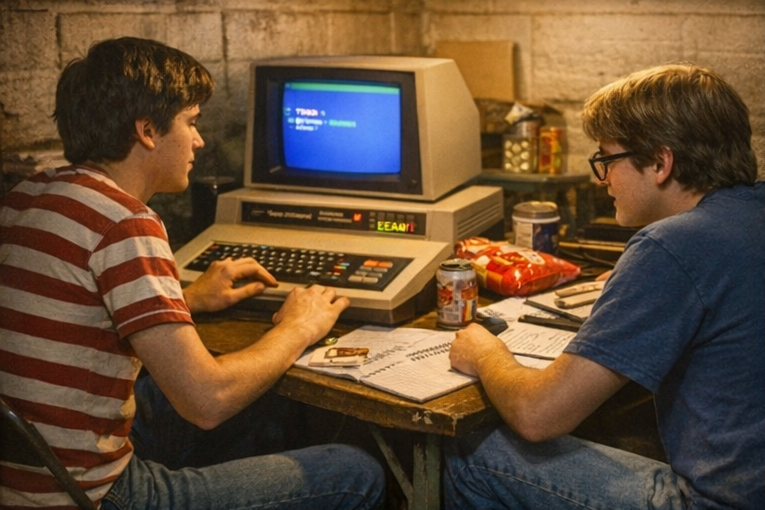
On a folding table sits Dave’s pride and joy: a Tandy TRS-80 Color Computer. It looks like a civilized piece of office equipment that accidentally became a portal. The keys are slightly springy, the case is a warm beige, and when it’s powered on the screen glows with that bright, confident blockiness that makes everything feel possible.
Across town, in Doug’s bedroom, there’s a different kind of machine: a Commodore PET 4016, a monolith with a built-in monitor, built-in keyboard, and built-in attitude. The PET doesn’t look like a toy at all. It looks like something that belongs in a lab where serious people in white coats do serious things. It hums softly like it has secrets.
And Dave and Doug—two teenagers with notebooks full of scribbled code and pockets full of cassette tapes—are about to find out that computers aren’t just for games.
They’re for control.
The First Summoning
When Dave turns on the CoCo, it greets him like a patient teacher:
OK
Doug’s PET does the same, except it somehow feels more judgmental:
***** COMMODORE BASIC 4.0 ***
31743 BYTES FREE
READY.**
That “READY.” is a dare.
They meet after school with backpacks clunking—textbooks, graph paper, a couple of tapes, and the kind of snacks that can survive being forgotten under a bed for a week. Dave has the CoCo manual. Doug has the PET book. They both have the kind of confidence you only get when you don’t yet know how deep the rabbit hole goes.
They start with BASIC, the way everyone starts.
Dave types:
10 PRINT "HELLO"
20 GOTO 10
On the screen, the word HELLO pours downward like a waterfall until Dave panics and hits BREAK.
Doug does the same on the PET, except his HELLO prints with the square, upright certainty of PETSCII, the PET’s own odd little dialect of symbols and letters.
They laugh, because they’ve made the machine do something. That’s the hook. The first bite.
Then they start doing what all kids do when they learn a power exists:
They try to make it misbehave.
BASIC Becomes a Playground
At first, their programs are small and proud.
A little number guessing game. A bouncing asterisk. A program that asks for your name and then greets you like the computer is your friend.
But quickly BASIC becomes less like writing and more like building traps.
Doug writes a tiny program that fills the screen with random characters.
Dave writes one that changes colors, because the Color Computer feels like cheating: it can do color. He writes a loop that cycles text through red, green, blue, and something that looks like a sunburnt orange.
They compare notes like explorers comparing maps.
Doug says, “The PET doesn’t do color, but the characters… look.” He finds the block graphics—the little half-blocks and lines—and suddenly he’s drawing boxes and patterns and weird checkerboards that look like alien architecture.
They learn quickly that BASIC is the polite way to talk to the machine—but not the only way.
Somewhere in the manuals, like a forbidden spell printed in plain ink, they see it:
PEEK
POKE
They stare at those words like they’re dangerous.
Which they are.
The Secret Door: PEEK & POKE
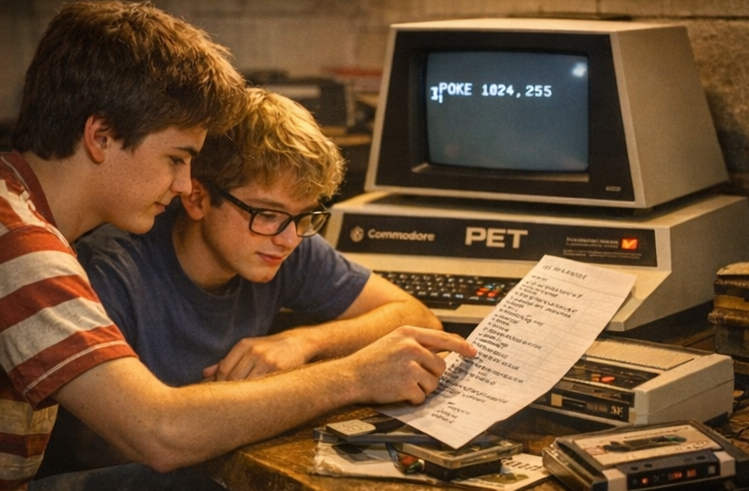
Dave’s manual explains it gently: memory is just numbers stored at addresses. You can look at a number with PEEK. You can change it with POKE.
Doug reads it out loud as though saying it louder will make it make sense:
“POKE address, value.”
Dave leans in. “So… you can change what the computer thinks is true?”
Doug nods slowly. “Yes.”
This is the moment the hobby stops being about typing commands and becomes about stealing fire.
They begin carefully. Like kids testing ice thickness.
Doug tries:
PRINT PEEK(1024)
A number appears. He doesn’t know what it means. But it’s a number that came from inside the machine, and that feels like listening to someone breathe through a wall.
Dave tries a POKE that changes the screen border color, following a tiny example from the CoCo book. It works. The border flickers into a new shade.
Dave sits back. “I just… reached into the TV and turned a knob that doesn’t exist.”
Doug tries to poke something on the PET that adjusts cursor behavior and the screen does something strange—like it’s suddenly less sure of itself. He grins and immediately writes down the address like it’s treasure.
But POKE is also the first time they break things.
Doug pokes the wrong value into the wrong place and the PET fills with nonsense characters, then locks hard. No READY. No cursor. Just a frozen stare.
He reaches behind the PET and flips the switch off, then on. The boot-up message appears again—like the machine’s forgiven him, but only because it’s too young to hold grudges.
Dave does worse. He pokes something that makes the CoCo crash into a black screen. For a second, his stomach drops—the way it drops when you think you broke something expensive forever.
Then he cycles power and it comes back. A little scuffed, maybe. Or maybe that’s just how it feels when you realize you can hurt something you love.
They start to respect memory. Not fear it. Respect it like you respect a wild animal that might bite.
And that’s when Doug says it:
“BASIC is too slow.”
Dave looks at him.
Doug taps the PET’s case like it’s a door. “There’s faster inside.”
The Assembly Rumor
Assembly language is introduced to them like a rumor. Something older kids talk about. Something in magazines.
It’s not like BASIC, where you write “PRINT” and the machine nods politely.
Assembly is the language the machine dreams in.
Doug gets a thin booklet from a computer store rack—the kind that smells like cheap ink and ambition. It shows a few tiny routines. Little programs that do almost nothing but do it instantly.
Dave finds an article that talks about machine code bytes like they’re puzzle pieces: 169, 1, 141, 0, 2…
At first those numbers look like nonsense.
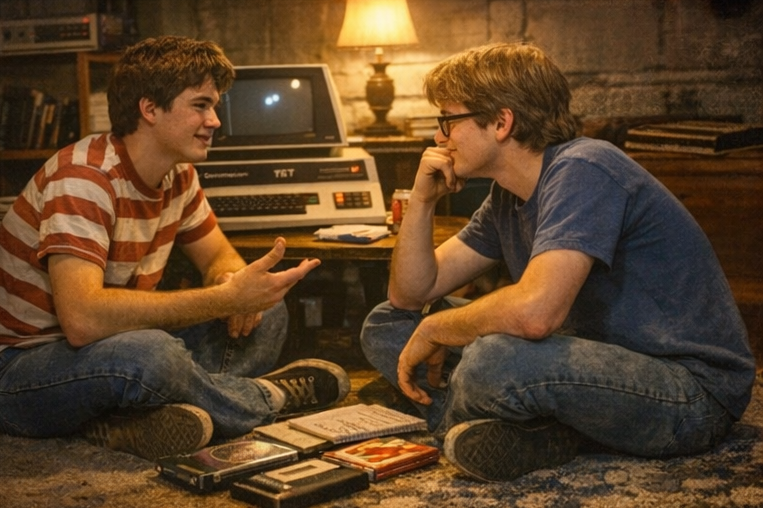
Then one night, sitting cross-legged on carpet with manuals spread out like sacred texts, the numbers begin to line up.
“WAIT,” Dave says, pointing at the CoCo’s notes. “So these aren’t random. They’re… instructions.”
Doug’s pencil hovers. “This number means load a value. This one means store it. This one means jump.”
They’re not writing programs anymore.
They’re writing movements.
They try it the most dangerous way possible: by POKEing machine code bytes into memory and jumping to them.
Dave writes a tiny routine he barely understands—something that changes a value that affects the screen—and then runs it with a command that feels like jumping off a roof and hoping you sprout wings.
It works.
The machine reacts like it got tapped directly on the brain.
Doug does the same on the PET. His routine draws something on the screen faster than BASIC could. It’s not beautiful. But it’s fast. It’s power.
They’re giddy.
And then they discover the real problem:
If they turn the computer off, it’s all gone.
All of it.
The tiny assembly routines. The experiments. The masterpieces and disasters.
Memory is a dream that evaporates when you wake up.
So they need a way to keep it.
That’s when they turn to the most ordinary-looking piece of the whole setup.
The cassette tape drive.
Tape Drives: The Squealing Library
Dave’s tape drive is a beige rectangle with buttons that feel like they belong on a cheap stereo. Doug’s is similar—plastic, practical, slightly flimsy. You wouldn’t trust it with anything important.
Which is hilarious, because they’re about to trust it with everything.
Saving to tape feels like a ritual.
Doug types:
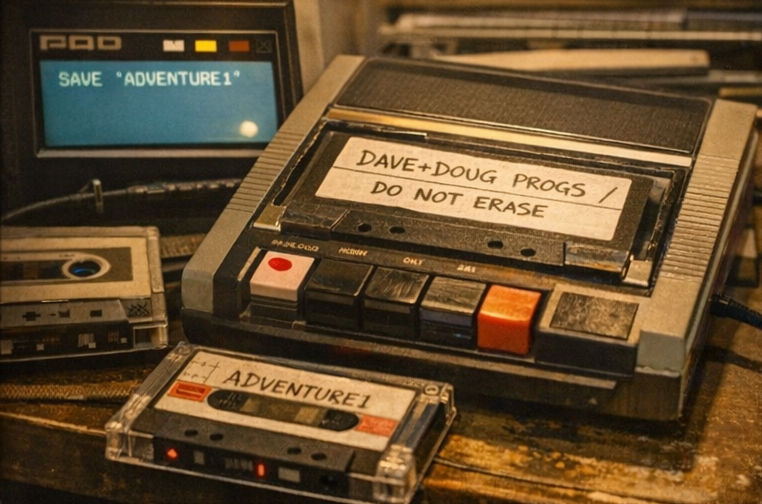
SAVE "ADVENTURE1"
He presses RECORD and PLAY on the tape deck like he’s launching a missile.
The PET makes that sound—sharp, warbling, like a robot trying to sing.
Dave does the same on the CoCo, and his drive answers with its own shriek. The first time they hear it, they both flinch.
“That can’t be right,” Dave says.
“It’s right,” Doug says, eyes wide. “That’s the sound of the future being written down.”
They wait, watching counters and listening to the screeching song of data. They treat the tape like it might explode if they breathe wrong.
When it’s done, they label it carefully in marker:
DAVE+DOUG PROGS / DO NOT ERASE
Of course, later, someone will almost erase it.
That’s just how tapes work. They’re physical, vulnerable, petty little things. They stretch. They jam. They get eaten.
And loading is worse.
Loading is hope plus patience plus superstition.
Doug types:
LOAD "ADVENTURE1"
RUN
He presses PLAY.
Sometimes it loads. Sometimes it doesn’t.
Sometimes it loads halfway and then stops, like the PET got bored or offended. Sometimes it returns an error that might as well say: Try again, mortal.
Dave learns to adjust the volume knob like he’s tuning a radio to find the exact threshold between too quiet and too loud. Doug discovers that if someone stomps on the floor during loading, it might glitch.
They develop rituals and rules:
- No talking during loading.
- No walking too hard.
- Don’t touch the cable.
- If it fails twice, rewind and try again.
- If it fails three times, swear at it quietly, then try again.
Each successful load feels like a miracle.
Each failed load feels like betrayal.
But when it works, when they hear the last chirp and the machine returns control like nothing happened, it feels like they’ve done something impossible:
They’ve stored thought on tape.
The Adventures Become Real
Once they can save and load, the projects get bigger.
They decide to make a game. Not just a little BASIC loop, but something with rooms and items and maybe even a map.
They sketch it on graph paper:
- Basement
- Alley
- Radio Shack
- School hallway
- “Computer Lab” (even if their school doesn’t actually have one yet)
- Secret room behind the arcade
They write BASIC code that prints descriptions, checks inputs, updates variables.
Then they use PEEK and POKE to speed things up—quick screen clears, faster input handling.
Then Doug insists on assembly for one part: a fast routine that draws a border and makes a little beep. Just a little flourish that BASIC could do, but assembly does snappier.
They begin to see the computer as layered:
- BASIC is the friendly face.
- PEEK/POKE is the side door.
- Assembly is climbing into the walls.
And the tape drive is the memory of it all.
They stay up too late, and when their parents yell down the stairs, they shout back:
“Just one more save!”
Because saving isn’t instant. Saving is a ceremony, and you don’t interrupt a ceremony.
Two Machines, Two Worlds
The differences between their computers start to matter.
Dave’s CoCo has color and feels alive in a way Doug’s PET doesn’t. Dave’s programs look like little arcade flyers—bright borders, colored text, a splash of drama.
Doug’s PET is stark, but his character graphics are sharp and clever. He makes rooms out of lines and blocks, invents little icons for keys and doors.
They trade code, but it doesn’t translate cleanly.
They can share ideas—logic, design, tricks—but the addresses are different, the memory maps are different, the whole personality is different.
They begin to understand something grown-ups don’t yet:
Computers aren’t one thing.
They’re a species.
Different models have different instincts. Different quirks. Different ways they break.
And breaking becomes part of learning.
They learn the joy of debugging the hard way—by staring at code until their brains go soft, then suddenly seeing the missing quote mark like it’s glowing.
They learn the pain of writing a perfect program and then watching a tape fail and realizing they never saved the latest version.
They learn to version their tapes:
ADVENTURE1
ADVENTURE1B
ADVENTURE1FIXED
ADVENTURE1FIXED2
ADVENTURE1FINAL
ADVENTURE1FINALREAL
There is never a final.
A Glimpse of Tomorrow
One night, late enough that the house is quiet, they sit in the dim light of the monitor glow and talk about the future the way other kids talk about cars or bands.
Doug says, “Imagine a computer that loads instantly. No tape. No waiting.”
Dave laughs. “That’d be insane. Like… what, you press a button and your program just appears?”
Doug shrugs. “Maybe it’ll be disks. Like records, but for data.”
Dave says, “And what if computers get small? Like… you could carry one.”
Doug snorts. “In your pocket? No way.”
Dave leans back. “What if they get so fast that BASIC feels slow. Like… you could do graphics like an arcade.”
Doug looks at the PET, then at the notebook full of memory addresses.
“What if everyone has one,” he says quietly. “Not just nerds like us. What if it’s normal.”
That thought hangs there.
Because it feels too big.
In 1981, computers are still weird. Still special. Still something you have to fight and coax and learn to speak to.
But in the glow of that screen, it’s easy to imagine a future where computers don’t live in basements and bedrooms.
They live everywhere.
Maybe they’ll be connected somehow, Doug suggests—like a phone line, but for computers.
Dave imagines typing something and having it appear on another computer across town without needing a cassette tape in between.
“That’d be like… telepathy,” Dave says.
Doug smiles. “Exactly.”
The Last Save of the Night
Before Doug goes home, they do one more thing: they save the latest version of their game to tape, both of them, separately, like making two copies of a treasure map.
Dave labels his tape carefully.
Doug rewinds his and listens for the right spot like a pilot checking instruments.
The machines shriek their data-song into plastic spools.
And when it’s done, they sit there for a moment, listening to the tape drive’s motor wind down.
It’s quiet again.
The future is stored on a strip of brown magnetic film, wound tight in a cheap plastic shell, sitting on a table beside a bag of chips.
Doug stands up and slings his backpack over his shoulder.
“Tomorrow,” he says, “we make it faster.”
Dave grins. “Tomorrow we make it smarter.”
They turn off the machines. The screens collapse into a single bright dot and then vanish, leaving the room dim and ordinary again.
But the ordinary room doesn’t feel ordinary anymore.
Because now they know there’s a hidden world behind the keys.
A world made of addresses and opcodes and the strange squeal of saved ideas.
And somewhere out there—years from now—there will be computers so fast and so smooth that nobody will believe the tape-drive era ever happened.
Nobody will believe that two kids once sat in the dark, trading PEEK and POKE secrets like contraband, and thinking:
This is the beginning.